Subject: Should
cigarettes be illegal?
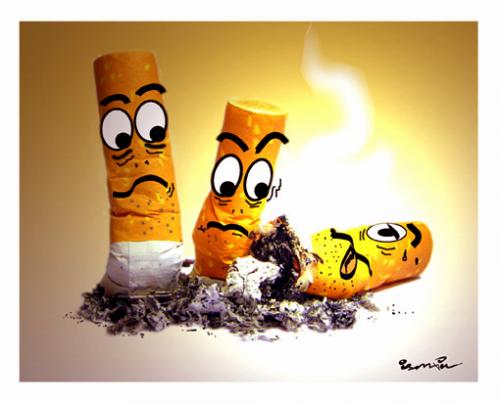
Cigarette use became widespread in
the late 1800’s when James Bonsack created the first cigarette-making machine (History). However, it was not until fairly recently
that people discovered just how harmful smoking cigarettes could actually be to
ones health. Some see smoking cigarettes
as a choice and believe banning them would be unethical while others evaluate
potential risks and can’t see any benefit in their widespread use.
According to the World Health
Organization, “every 8 seconds someone dies from tobacco use” (Smokers). However, it is a common misconception that
smoking is only linked to lung cancer and heart disease. In reality, smoking can also lead to stomach
ulcers, psoriasis, deformed sperm, and hair loss. One does not have to be a smoker to absorb
the effects of cigarette smoke. Environmental
tobacco smoke (second hand smoke), contains “7,000 chemical compounds…more than
250 of these chemicals are harmful…69 are known to cause cancer”(Secondhand). In fact there are, about 46,000 deaths from
heart disease in people who are non-smokers, and “3.400 lung cancer deaths in
non-smoking adults”(Secondhand). Smoking
cigarettes does not only negatively effect ones health, but also ones
wallet. In the United States, the costs
of extra medical care due to second hand smoke is more than $10 billion per
year (Smoking).
The illegalization of cigarettes would
have major economical effects. According
to the “Tobacco Atlas”, the profits in the tobacco industry are greater than
ever. They estimate that revenues from
“the global tobacco industry are likely to approach a half trillion dollars
annually”(New). Also, there are over
800,000 people working in the U.S. tobacco industry and over 136,000 farms
(History). Banning cigarettes would
leave hundreds of thousands of people unemployed across the U.S. However, the effects of banning cigarette
smoke would not only correlate to the economy but could also lead to the rise
of black markets. In a study done in
U.S. prisons, when a location changed its cigarette policy it was shown that
the emergence of black markets were prevalent.
This could foreshadow what may happen if cigarettes are banned
everywhere in the U.S. (Smoke).
In reality and based upon the facts,
making cigarettes illegal would cause public disarray. Discouraging one from smoking is much more
attainable, and introducing new policies either to the general public or in the
work force could successfully bring this idea into fruition. Wal-Mart has recently imposed higher premiums
on workers who are known smokers. They
reached this decision because “tobacco users generally consume about 25 percent
more healthcare services than nontobacco users”(Abelson). However, Wal-Mart did not stop there. The company has started offering an
anti-smoking program this year to aid employees in the process, and since then
more than 13,000 employees enrolled.
Another way to discourage an individual from smoking is by using
cigarette alternatives. In Italy,
Riccardo Polosa recruited 40 hard-core smokers and gave them each an
e-cigarette. The e-cigarette provides
the smoker with small puffs of nicotine “without the noxious substances found
in cigarettes smoke”(Tierney). After six
months, over half of the smokers cut their cigarette consumption by 50 percent
and “nearly a quarter had stopped altogether”(Tierney). Creating alternative ways to encourage
smokers from picking up a cigarette does work, and with a little effort, the
success seen by Wal-Mart and the creation of the e-cigarette could be a start
to a smoke-free future.
Works
Cited
Abelson, Reed. "The Smokers' Surcharge." The
New York Times. The New York Times,
17 Nov.
2011. Web. 04 Apr. 2013.
<http://www.nytimes.com/2011/11/17/health/policy/smokers-penalized-with-
health-insurance-premiums.html?pagewanted=all>.
"History of
Tobacco." History of Tobacco. N.p., n.d. Web. 05 Apr. 2013.
<http://healthliteracy.worlded.org/docs/tobacco/Unit1/2history_of.html>.
"New Tobacco Atlas Estimates U.S. $35 Billion Tobacco
Industry Profits and Almost 6
Million
Annual Deaths." N.p., n.d. Web. 08 Apr. 2013.
<http://www.worldlungfoundation.org/ht/display/ReleaseDetails/i/20439/pid/685
8>.
"Secondhand Smoke." Secondhand Smoke.
N.p., n.d. Web. 04 Apr. 2013.
<http://www.cancer.org/cancer/cancercauses/tobaccocancer/secondhand-smoke>.
"Smoke ’Em If You Got ’Em: Cigarette Black Markets In
U.S. Prisons AND Jails." N.p.,
n.d. Web.
<http://www.ncbi.nlm.nih.gov/pmc/articles/PMC2117377/>.
"The Smokers Body." COLORS Magazine, 21 July 1997.
Web. 05 Apr. 2013.
<http://www.can.org.na/docs/smokers.pdf>.
"Smoking&Tobacco Use." Centers for
Disease Control and Prevention. Centers for
Disease
Control and Prevention, 18 Dec. 2012. Web. 05 Apr. 2013.
<http://www.cdc.gov/tobacco/data_statistics/fact_sheets/fast_facts/>.
Tierney, John. "FINDINGS; A Tool to Quit Smoking Has
Some Unlikely Critics." The
New York
Times. The New York Times, 08 Nov. 2011. Web. 05 Apr. 2013.
<http://www.nytimes.com/2011/11/08/science/e-cigarettes-help-smokers-quit-
but-they-have-some-unlikely-critics.html>.

I didn't know that smoking affects someone every eight seconds. I know that while it is something that is starting to become less prevalent in advertising in the united states, that is not the case in other countries where smoking is still being marketed as cool to young kids.
ReplyDelete